 |
| Second Chance Month: Understanding the Criminal Justice System |
 |
| Research Gate: Two in One: Differences in the US justice System for the Rich and the Poor |
 |
| Duke Today: All White Jury Pools |
In most big cities there is an area of lower income individuals who live in what is known as "the projects". Although both black and white individuals live in these areas, the majority of the location is home to people that are black or latino. When you grow up in environments like the projects where, money is low, drugs are common, there are gang affiliations, you may not have a full family, and school is not mandatory, it is much easier to get into tough situations than if you lived in an upperclass family with lots of money and a house in a gated community. If money runs low for a family, someone may just steal from the local grocery store, or steal from someone at school. This is an issue that disregards race completely, but relies solely on income and home life. On the Huff Post, it said that blacks do not get as much right to a lawyer as whites do. When you are of a lover class, you get a government or state appointed lawyer which takes time and money that you may not have. This once again does not regard race, but your income. If someone came into a prison and could immediately afford a lawyer they would take precedence over someone who does not have everything together yet. Most of the lower class population is black or latino, and instead of blaming the system on racial inequality, maybe it should be chastised for class inequality. Obama once said, "The injustice is in the growing divide between Main Street and Wall Street." (National Affairs: Justice, Inequality, and the Poor). The divide of injustice is not based on unfairness in the judicial system based on race, but one based on wealth. However, there are still situations we, as Americans can handle better.
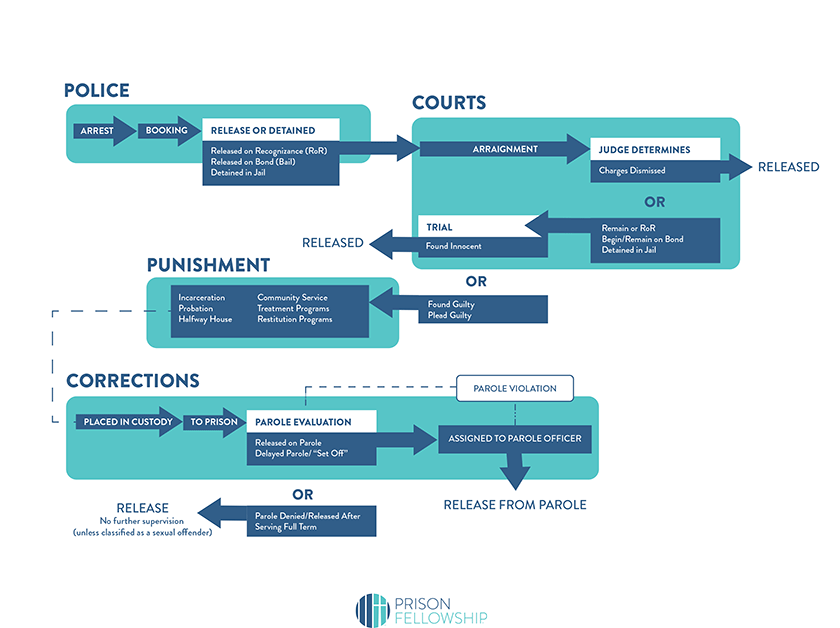
Racism is still a thing that happens to this day, although not seen as much as in the past. The news can portray specific races as threatening, like latinos. 66% of the time Latinos are on the news it is because of immigration or an illegal act, and on average latinos only make 87 seconds of news per day (Center for American Progress: The Dangerous Racialization of Crime in the US News Media). For someone at home this gives a bad view of this race, even though everyone is not like this. 80 percent of NYPD stops were blacks or latinos this past year, (Huff Post: Fourteen Examples of Racism in Criminal Justice System). This number is too large for a community who desires equality in its borders. There is also the diagram above of the court case, and how black individuals are not always on jury duty and how this should be a solved resolution. I will like to agree with that, but there is no way of proving that the people incarcerated were incarcerated due to race and not luck of the draw. Also, the police brutality where policemen kill innocent black people out of unnecessary fear is something that should be fought for as well. I believe what the EJI is fighting for should be reevaluated to not fight for criminal justice equality inside of the court, but outside of the court. The rights of black men and women to be on the streets and not fear being pulled over or walking alone. Or maybe they should stand for class inequality, because when someone is raised in a poor community, they are much more likely to attend jail, and need all the help they can get when they go in jail and after.
Sources:
Sage Journals: The Criminal Justice System and the Racialization of Perceptions
Huff Post: Fourteen Examples of Racism in Criminal Justice System
Center for American Progress: The Dangerous Racialization of Crime in the US News Media
EJI: Race and the Criminal Justice System
National Affairs: Justice, Inequality, and the Poor
The United States Department of Justice: Incorporating Racial Equality Into Criminal Justice Reform
Quartz: New Data Clearly Illustrates the Poverty- to- Prison Pipeline
Comments
Post a Comment